Introduction
This is a collection of thoughts that I have been carrying with me for some time. When I was born, in 2001, there was already some technology and also Moore’s Law, which says that the number of transistors on a chip will double every 18–24 months. He was right; chips have doubled over the years. Intel’s first processor, the Intel 4004, released and manufactured in 1971, had only 2,300 transistors. And not so surprisingly, Apple’s A17 chip, released and manufactured in 2023, has 19 billion transistors. Can you imagine? From my side, I cannot!
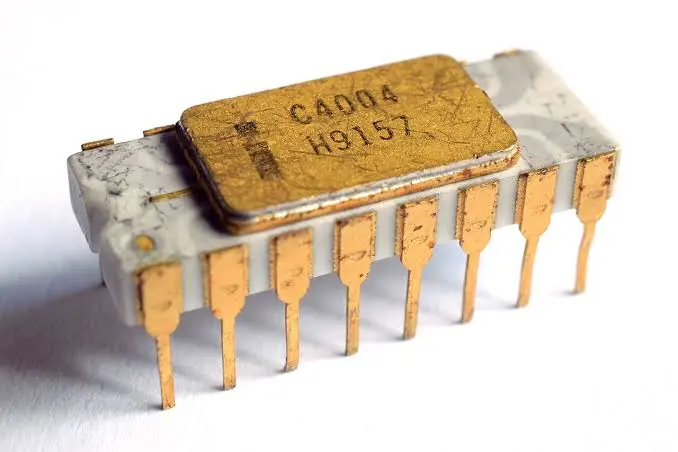
Before transistors were ever made, there were vacuum tubes. And before that, we had mechanical and steam-powered systems. However, creating automated systems is not a 100-year-old concept; on the contrary, it is perhaps one of our oldest endeavors. Humanity has always been interested in computing. It could be done by fingers, by thinking, or by using an abacus; it could also be done by a mechanical calculator, or it could be done by punched cards. But to understand the theory of computing, we had to wait for Ada, Boole, Babbage, and Frege to enter the stage of history. They provided a strong basis for logical algebra that is still used in the logic of transistors. What we call “Boolean algebra” was created by Boole.
I am always amazed by the brains behind the idea of computers, especially those who are our muses and founding fathers of modern computer science: Alan Turing and John von Neumann. These people were exceptional—geniuses, thinkers, philosophers, and game-changers. In some other blog post, we can and will elaborate on the journey of computer science. But now, in this article, I am interested in what was written after the “Computing Machinery and Intelligence” paper written by Alan Turing. Seven years after “Computing Machinery and Intelligence” was published, and three years after Turing was killed by the government he lived in, Rosenblatt published the “Perceptron” paper in 1957. It was one of the early statistical learning models. In 1970, Seppo published the “Automatic Differentiation” paper. It introduced a computational technique that made gradient-based optimization scalable. I do not want to bother the reader with mathematics or physics or computer science.
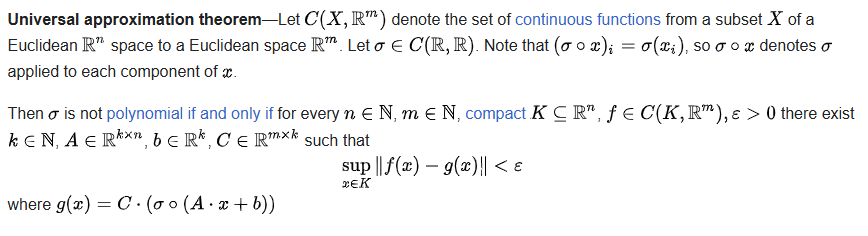
I think 1988 was the year that demonstrated the potential of neural networks to researchers, since Kurt Hornik proved the Universal Approximation Theorem. It showed only the potential, though; to understand the practical realization of that potential, we had to wait for GPUs and more powerful computing systems to emerge. Anyway, the UAT says: A feedforward neural network with at least one hidden layer and a suitable nonlinear activation function can approximate any continuous function on a bounded input space arbitrarily well, provided it has sufficiently many neurons. The UAT is a representational theorem, not a training or performance guarantee. I do not want to bother reader with the mathematical sh*t, basically UAT is the tool that enables us to say “yeah sure AI can do that”. Those who has interest
Before 2017, we had models with limited context length and a sequential computation constraint; they were capable of dedicated missions. In 2017, Vaswani and his team published the “Attention Is All You Need” paper, which replaced recurrence/sequential computation with a mechanism based on self-attention. The rest of the history is something the modern world has called the “AI Revolution.”
Problem of Syntheticness
I hardly remember the time when OpenAI had not yet participated that much. In those times, companies did not generate a model every month. Well, I cannot complain about the speed of improvement; instead, I love this rapidness, this untrackability. AIs are my best companions when I need a hand. They often support my thinking process. But I never let my thinking be taken over by AIs. Recently an OpenAI model has contributed to solving an Erdős problem without human intervention, I think this is not something that one should read and pass over. It is something that one should sit and think about. Erdős problems generally consist of hundreds of famous, difficult mathematical problems/conjectures stated by the Hungarian mathematician Paul Erdős. That is why I named this section “Problem of Syntheticness.”
When I saw that an AI had solved an Erdős problem, I could not believe it. And then I thought to myself, alone, with no auxiliary AI. Again, I loved the rapidness of these enhancements. I thought about the AI-generated videos created on the Internet, about how real and how plastic they are. Everyone remembers Will Smith’s pasta video published back in 2023. When I compare it with the 2026 version, I would say words fail me.
There is always a “however” with me. In this post, I want to mention two types of art. One of them is a type of painting, and the other is music. I am not convinced that today’s AI can create truly great art (at least this year :D). For instance, take Necmeddin Okyay’s marbling with flowers.
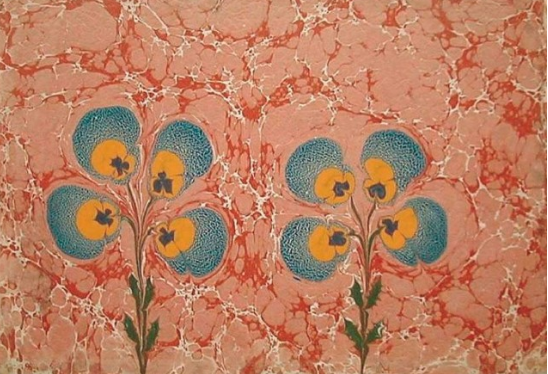
In this marbling, I feel something that AI cannot generate. Maybe it is because I know that, once upon a time, somebody sat down in front of his ebru tray and thought about colors, flowers, shapes, and forms. Maybe that is why I feel this way. And then I generated an image of flower marbling.
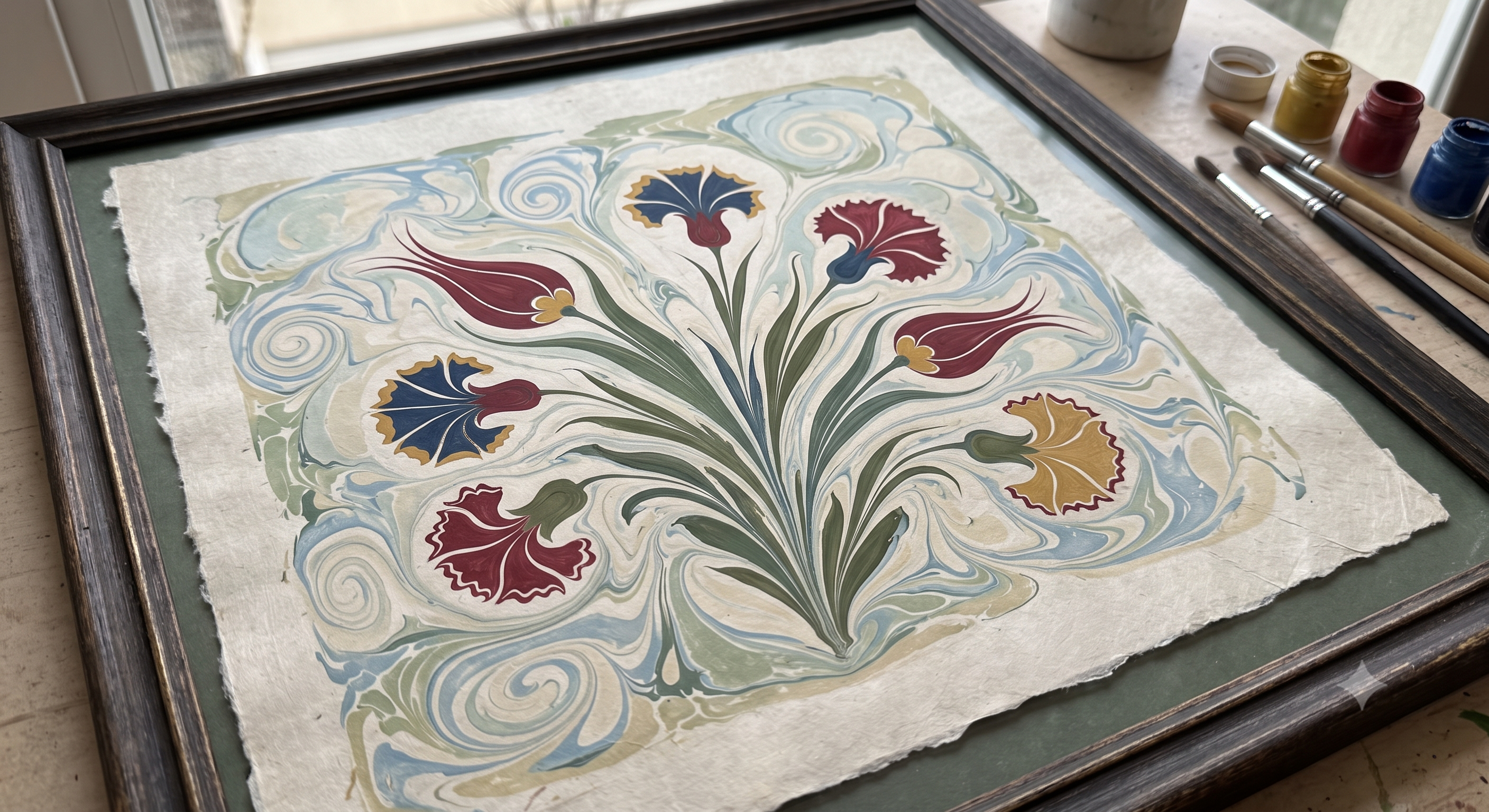
I do not know if you would agree with me, but it looks as sloppy as possible. There is no tranquility, harmony, or serenity as there is in Necmeddin Okyay’s work. It all looks unnatural, artificial, and, most importantly, imitated. Nothing creative or new.
Problem of Thinking
On the other hand, we, humans, have a powerful computational tool called the brain. It helps us survive on Earth, create civilizations, be creative, create art, and yet also be vindictive enough to initiate a war. The brain is the best tool we possess, and it is even more powerful when combined with our hands. Since antiquity, humans, especially philosophers, have debated the nature of knowledge and how to access it (if it really exists).
As for me, I have not deep-dived into that philosophical side. I just learnt and learn, I read and read, I studied and study. According to the universe itself, among 8.3 billion people, I am nobody. I am writing this blog post with the background music “The Day of the Night,” composed by a real person called Akira Yamaoka. Recently, I have been thinking about the question: as in the famous article, is attention all we need? I have no answers to that. Though nobody has ever had an answer, not even Descartes, Plato, Nietzsche, Kierkegaard, and so on.
Problem of Not Thinking
This section of post is a bit terse, because Frank Herbert’s 1965 novel Dune summarized this idea beautifully. “Once men turned their thinking over to machines in the hope that this would set them free. But that only permitted other men with machines to enslave”. So never stop thinking by yourselves, alone. Maybe with a piece of paper and a pen.
Problem of Future
I do not fear AI itself, instead I have a commitment. Some kind of relationship that make me curious, skeptic, faster, and more capable. Even more creative. I also thought “what if?” scenario. A scenario that AI happens to be vanished. I am already convinced that I would continue what I am doing, and this feels good.