Where does crisis come from
In the last chapter we talked about Russel’s paradox and the need for a formalized system of mathematics. In this section of the blog, we will discuss why mathematics needed to be formalized and what ideas were involved. A mathematician called Cantor created the set theory in the 1870s, he was confident about his theory. He did make a real leap in mathematics in terms of modernization. I mentioned naive set theory a little bit here. Well, I’m not someone who can criticize Cantor, but Bertrand Russell did. He developed a very clever paradox that created a major bottleneck in set theory.
After the paradox was discovered by Bertrand Russell, a debate known as the foundational crisis of mathematics arose. It lasted from the late 19th century to the mid-20th century. This crisis revealed that mathematics might contain profound gaps. Gaps so significant that they drove mathematicians to reconstruct the discipline from its very foundations. One of the mathematician, who wanted to reconstruct the mathematics was David Hilbert
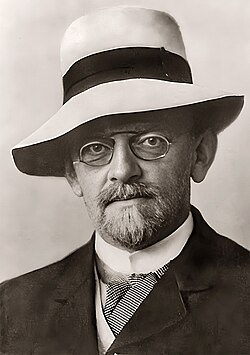
Program
He developed program, which has three aim points and he named it Hilbert Program. One of the aim was Widerspruchsfreiheit, in other words consistency. He stated that in the formal system, using the rules of the system both $P$ and $\neg P$ cannot be proved. Either one of them should be true. The second aim was Vollständigkeit, in English completeness. This word could be familiar to the reader who is interested in mathematical logic because Gödel’s paper addressed this issue. He stated: Every true proposition in a system must be provable using only that system’s own axioms and rules. In other words, there should be no statement that is “true but unprovable” within the system itself. This reads total independence. Last aim was Entscheidungsproblem, which implies for every statements in mathematics there should be an algorithm to decide whether the statement is true or not.
Pre-information
We are far away from talking about Gödel’s proof, yet we can say that they undermined Hilbert’s Program. The two theorems known as the “first incompleteness theorem” and the “second incompleteness theorem” were the executors of the aims “Widerspruchfreiheit” and “Vollständigkeit”. “What happened to the Entscheidungsproblem?” you might say, well it was also defeated by Alan Turing.
Absolute and Relative proofs
Vollständigkeit
Before understanding and explaining Gödel’s achievement on system consistency, we shall give what Hilbert did to construct the consistency of a system. Hilbert did construct something called “absolute” proofs, by which consistency of systems could be established without relying on the consistency of other systems (elliptic geometry’s consistency relies on Euclid and etc.).
Preliminaries from Hilbert
Hilbert wanted to develop absolute proofs so that the consistency of the system can be proved without relying on other systems. Relative proofs establish the consistency of a mathematical theory $T_2$ by assuming the consistency of another theory $T_1$. More rigorously, $Con(T_1) \rightarrow Con(T_2)$. This reduces the trustworthiness of a new complex or suspicious theory $T_2$ to that of an older and simpler theory $T_1$ that we have already trusted. A great example of this is the relation between non-Euclidean geometry and Euclidean geometry as we have mentioned in here.
The absolute proofs were gold and were the holy grail sought by David Hilbert. They are the proofs that establish a consistency of theorems directly without assuming the consistency of any other theorems. “Why are they so important?” you might say, because they provide a rock-solid, final foundation for the most basic theory of mathematics (According to Hilbert, Arithmetic or Number Theory were the most basic theories in mathematics).
Steps to achieve absolute proofs
Hilbert said that we must completely formalize the deductive system. By saying deductive system he meant the abstract structure consisting of axioms and rules of inference that can be used to derive theorems of the system. Normally, when we write or say $1+1 = 2$ we directly say this has a meaning. Here the symbol $1$ stands for oneness and $+$ represents the operation between two oneness.
However, according to Hilbert’s formalization the axioms and theorems of a completely formalized system are just “strings” of meaningless “marks”, constructed according to rules for combining the elementary signs of the system into larger wholes. Hilbert said: “Let us temporarily forget the entire meaning of mathematics. Paradoxes arise from our intuitions and the way we approach meaning.”
After turning mathematics into meaningless marks and strings. We can create meaningful statements about string itself that are not the topic of the system. It might sound complicated but he proposed something I call “bird’s-eye view” to mathematics. Because, we stop thinking of the meaning of mathematics and step back to see the big picture. According to the Hilbert, the meaningful statements about string itself are called meta-mathematics. Meta-mathematical statements are statements about the signs occurring within a formalized mathematical system.
Examples
Examples I am about to give will clarify the understanding. If we write an expression $1+2 = 3$. We can easily say that this statement is about mathematics itself. It tells something about mathematics. However, if we write above statement as follows: ’$1+2=3$’ is an arithmetical formula, then it tells about the expression ‘1+2=3’. Moreover, the statement does not tell anything about arithmetics. It now belongs to meta-mathematics. It falls within the scope of meta-mathematics, as it describes a particular mathematical symbol as a member of a specific category of symbols.
Another example can be the following: “Formal system $X$ is consistent”. In other words, it is not possible to constitute two formally contradictory formulas from the axioms of the system. If we say that Bienenstich (a dessert from German cuisine) is more delicious than Berliner this statement belongs to culinary; but if we say that this statement is meaningless and unprovable then it belongs to meta-culinary.
The Goal
Hilbert’s grand plan was to use meta-mathematics to prove the consistency of mathematics. He wanted to show, by exhaustively examining the structural properties of the formal system, that “formally contradictory formulas cannot be obtained from the axioms”. For example, he wanted to prove meta-mathematically that the system could never produce both $0=0$ and its formal negation, $\neg (0=0)$. The final requirement was that this meta-mathematical proof must be “finitistic”.
- This means the proof itself can only use simple, finite methods of reasoning.
- It cannot “make reference… to an infinite number of structural properties… or to an infinite number of operations”.
- Hilbert believed you could prove the consistency of arithmetic by examining its finite structural properties.
To sum up
The steps on Hilbert’s mind was:
- Formalize a mathematical system (e.g., arithmetic) so it becomes a “meaningless” game of symbols.
- Separate this “mathematics” (the game) from “meta-mathematics” (meaningful statements about the game’s structure and rules).
- Use simple, finite, and absolutely reliable “finitistic” reasoning within meta-mathematics to prove that the formal system of mathematics is consistent.