Some Intuition
Readers who have gone through the previous sections may already suspect that the concept of a limit for functions should be analogous to the concept of a limit for sequences. Well those readers were not mistaken; they are indeed quite similar. Our main aim for this and next posts is to state limits and contuinity mathematically. However, I will show three eccentric functions to rebuild the contuinity intuition of readers.
At high-school and at some majors (engineering and etc.) it is said that a function is continuous if you can draw it without picking your pencil up. In other words, if there is no gap then function is said to be continuous. However, we have powerful counter-examples to that statement.
After memorizing “a function is continuous if you can draw it without picking your pencil up” we are generally taught that $f$ is continuous at $c$ if
$$\lim_{x\rightarrow c} f(x) = f(c)$$
Well, although there is nothing wrong with this statement, it is not quite right. We have to understand why we used, what we used. Thanks to our intuition, we can see as $x$ goes very near to $c$, $f(x)$ also gets very near to $f(c)$.
Before understanding what continuity is, let us understand what is meant by saying: $$\lim_{x\rightarrow c} f(x)$$ Then in the next section we will understand what is meant by $f(x)$ continuous at c
Dirichlet’s Function
Can you define a function that nowhere continuous? You could have done that if a mathematician called Dirichlet would not have defined it. He basically defined a function that $f(x)$ is equal to $1$ whenever $x$ is rational and $0$ whenever $x$ is irrational. Rigorously,
Consider $\lim_{x \rightarrow 3} f(x)$ and the sequence $(a_n) = (3-\frac{1}{n})\in \mathbb{Q}$. So $f(a_n) = 1$. Thus, $f(a_n) \rightarrow f(c)$. However, $(b_n) = (3-\frac{\sqrt(2)}{n}) \notin \mathbb{Q}$ since $\sqrt(2)$ irrational and thus $f(b_n)$ does not converge to $f(c)$ for all $n$. So the convergence depends on sequence we pick.
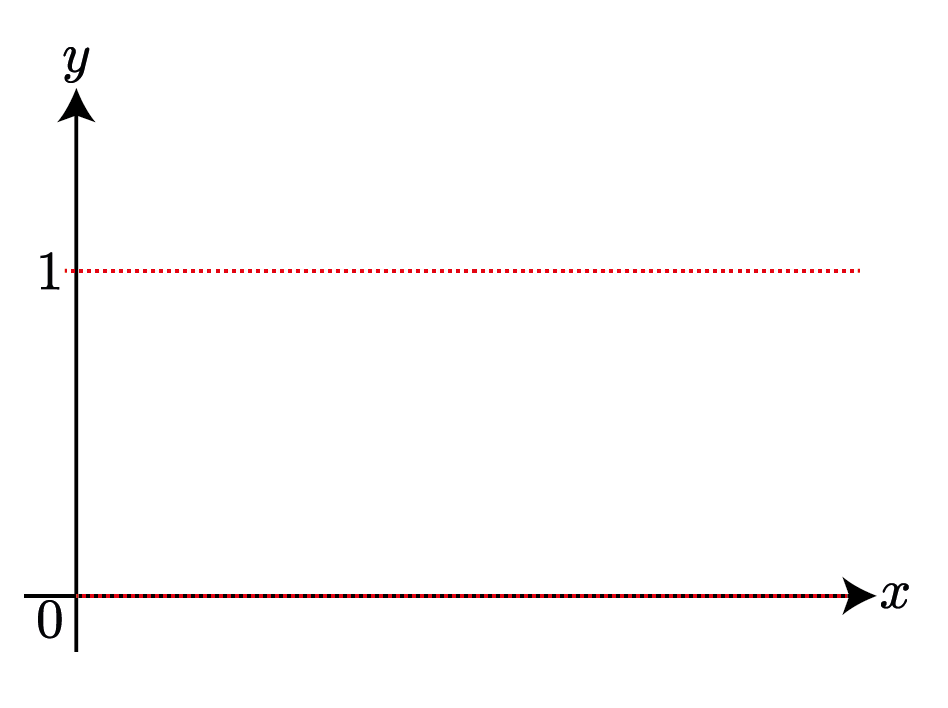
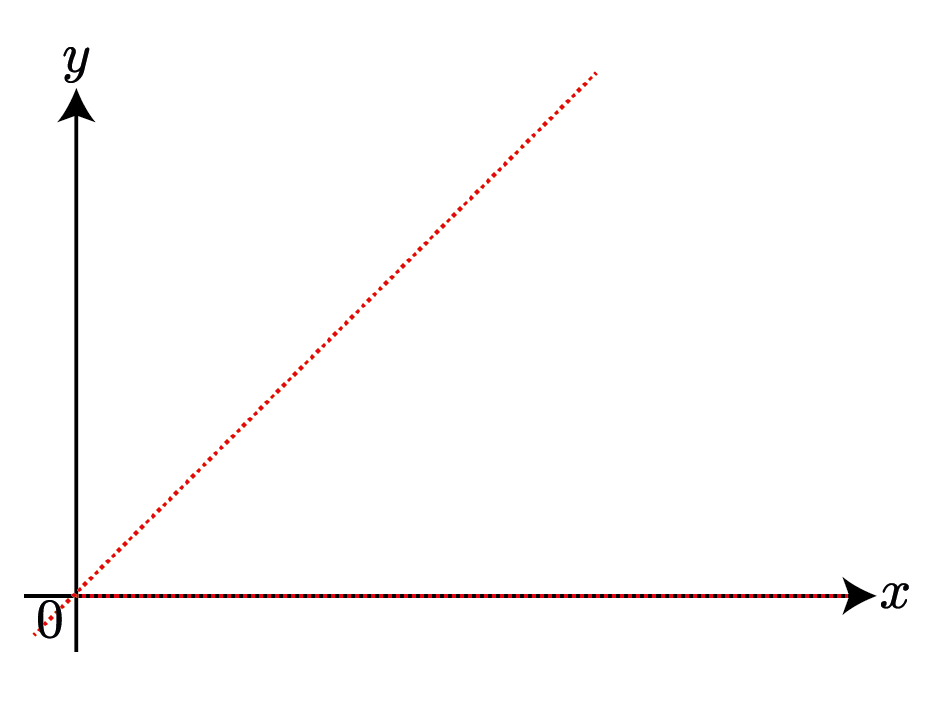
And natural question arise: is there a function which is continuous only one point? As you could guess, the answer is “yes”. A modified version of Dirichlet’s function continuous only on $0$.
What we have said above is that “not picking pencil up” does not imply contuinity. Because, in the graph there are infinitely many dots (in order to write dots, one should pick up a pencil and then pick down).
Thomae’s Function
Thomae’s function is bizarre so to say. Basically, it is only continuous when the input is irrational and discontinuous if the input is rational. We will prove it in the next section. But the graph of Thomae’s function is below:
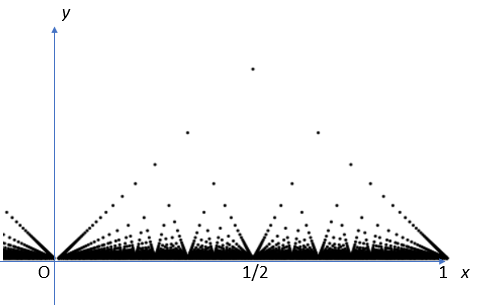
My plan for proof is to divide into steps: first, intuition of proof and numerical substitutions and second formally prove contuinity.
Definition of Functional Limit
We have to state functional limit very clearly in order to proceed with contuninity. It is pretty flexible. We should take a domain $A$ subset of $\mathbb{R}$ and function maps to $\mathbb{R}$. Namely, $f: A \rightarrow \mathbb{R}$. Most importantly $c$ a.k.a. limit point does not have to be in $A$. Well, it is not that surprising because you may remember from calculus that there are some limits with indeterminate forms, which can be solved using L’Hôpital.
Remember that limit points of $A$ do not necessarily belong to the set A unless A is closed. Let us give the definition while keeping these in mind.
$\textbf{\small Definition 1.24.:}$ (Functional Limit) Let $f: A \rightarrow \mathbb{R}$ and let $c$ be a limit point of domain $A$. We say that $\lim_{x \rightarrow c} f(x) = L$ provided that, for all $\varepsilon > 0$, there exists a $\delta > 0$ such that whenever $0 < |x - c| < \delta$ it follows that $|f(x) - L| < \varepsilon$.
There should be some comments to the definition:
- Since limit only interested in approaching and not exact value, it DOES make sense to write $0 < |x - c|$. It basically implies $x \neq c$.
- Below picture depicts rough idea of limit when $x$ approaches to $L$. Combining it with definition we can say that if $x$ has the property $0 < |x - c| < \delta$, then $f(x)$ also has the property $|f(x) - L| < \varepsilon$.
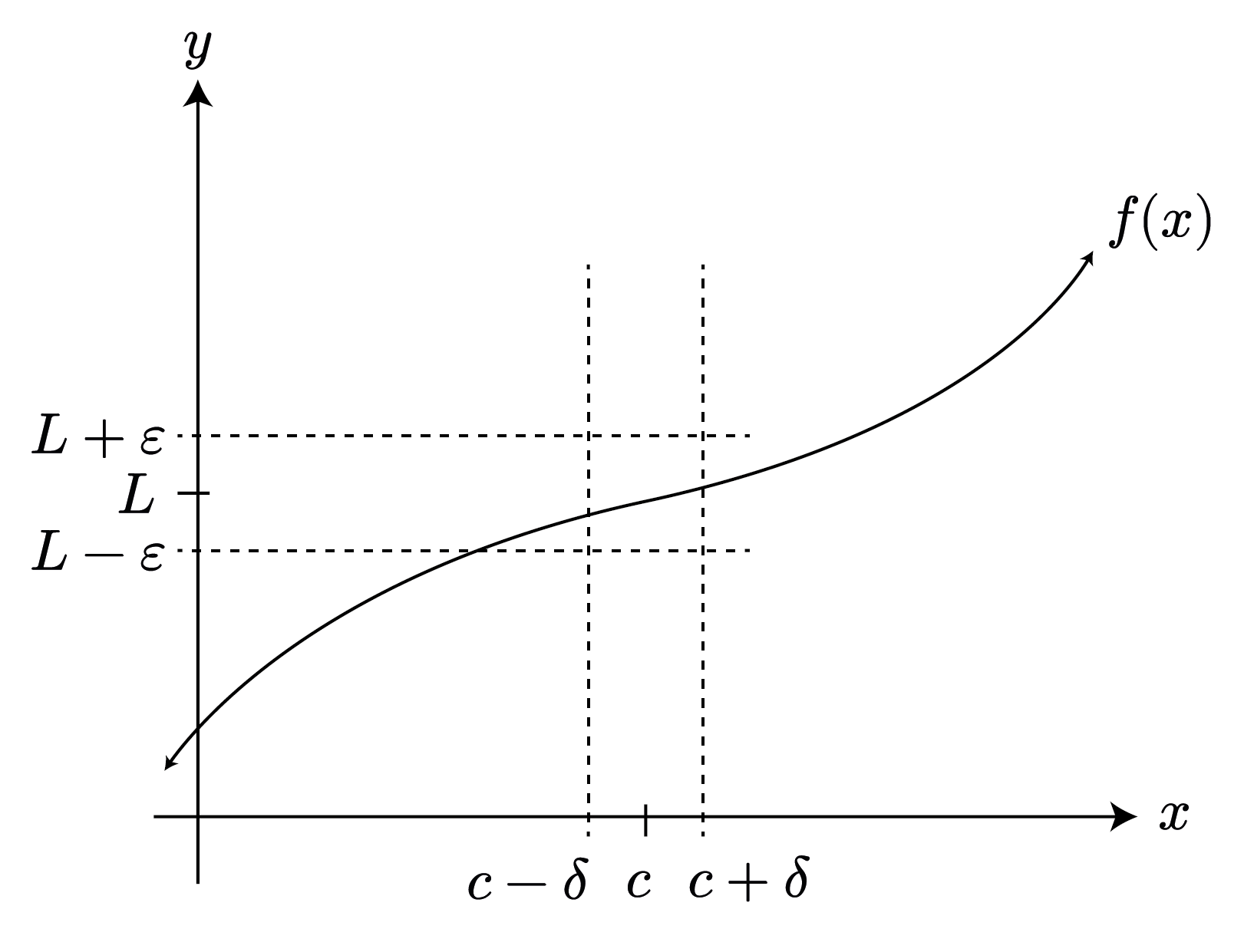
- To prove $\lim_{x\rightarrow c}f(x) \neq L$, we can negate the definition above, which is: there exists some $\varepsilon > 0$ such that for all $\delta > 0$ there exists some $x \in A$ satisfying $0 < |x-c| < \delta$ for which $|f(x) - L| \geq \varepsilon$. Below picture shows that $\varepsilon > 0$, which proves $\lim_{x\rightarrow c}f(x) \neq L$ could be found.
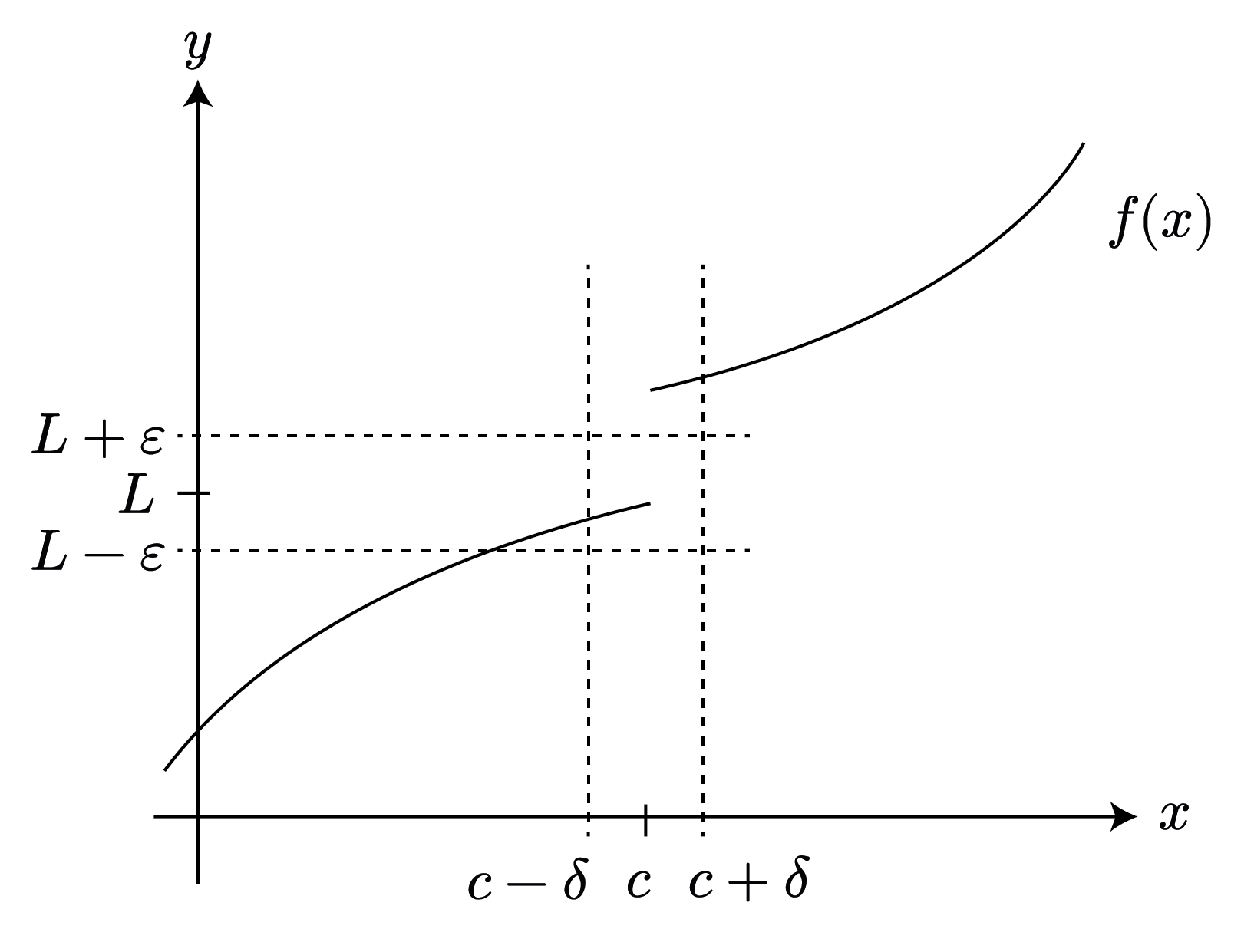
Before moving on to the properties, it should now be clear that $\lim_{x \rightarrow c} f(x) = f(c)$ means exact same thing as "$f$ is continuous at a point $c$". Let’s now use the limit definition with a simple example:
$\textbf{\small Example:}$ Prove that $\lim_{x \rightarrow 3} (2x-1) = 5$
$\textbf{\small Solution:}$ Let $\varepsilon > 0$ be given. We want to find $\delta > 0$ such that $0 < |x-3| <\delta$ then,
If we choose $|x-3| < \frac{\varepsilon}{2}$, then $|f(x)-5|<\varepsilon$. Hence, we take $\delta = \frac{\varepsilon}{2}$, then $0 < |x-3| < \delta = \frac{\varepsilon}{2}$.
Properties of Functional Limit
It can be guessed that most of the properties satisfied by sequences are also satisfied by functional limits. Let’s elaborate
$\textbf{\small Proposition 1.1.:}$ (Functional limits are unique) A limit $\lim_{x \rightarrow c} f(x)$ can only converge at most one value.
I will not give proof of this proposition, because reader can easily prove using this post.
$\textbf{\small Theorem 1.24.:}$ Assume that $A \subseteq \mathbb{R}$, $f: A \rightarrow \mathbb{R}$, and $c$ is a limit point of $A$. Then $\lim_{x \rightarrow c} f(x) = L$ if and only if, for every sequence $a_n$ from $A$ for which $a_n \neq c$ and $a_n \rightarrow c$, we have $f(a_n) \rightarrow L$.
We used this idea in here.
$\textbf{\small Proof:}$ $(\Rightarrow)$ Suppose $\lim_{x \rightarrow c} f(x) = L$. Then $\forall \varepsilon > 0$, $\exists \delta > 0$ such that if $0 < |x - c| < \delta$, then $|f(x) - L| < \varepsilon$. Let $(a_n)$ be a sequence such that $a_n \neq c$, $\forall n \in \mathbb{N}$ and $\lim_{n \rightarrow \infty} a_n = c$. Then $\exists N = N(\varepsilon)$ such that $\forall n > N$ and $0 < |a_n - c| < \delta$. This simply implies $|f(a_n) - L| < \varepsilon$.
$(\Leftarrow)$ Suppose that $\forall (a_n)$ in the domain of $f(x)$ with $a_n \neq c$, $\forall n \in \mathbb{N}$ and $\lim_{n\rightarrow \infty} a_n = c$ we have $\lim_{n\rightarrow \infty} f(a_n) = L$. Suppose $\lim_{x \rightarrow c} f(x) \neq L$. Choose $\delta = \frac{1}{n}$ we get $x_n$ with $|x_n - c| < \frac{1}{n}$ and $|f(x_n) - L| \geq \varepsilon$. But $|x_n - c| < \frac{1}{n}$ implies that $x_n \rightarrow c$. So we have found a sequence $(x_n)$ converging to $c$ for which $|f(x_n) - L| \geq \varepsilon$ and hence $f(x_n) \nrightarrow L$. This contradicts our hypothesis. Thus, $\lim_{x \rightarrow c} f(x) = L$.
$\textbf{\small Theorem 1.25.:}$ Let $\lim_{x\rightarrow x_0} f(x) = l_1$ and $\lim_{x\rightarrow x_0} g(x) = l_2$
$\lim_{x\rightarrow x_0} (f(x) \pm g(x)) = \lim_{x\rightarrow x_0} f(x) \pm \lim_{x\rightarrow x_0} g(x) = l_1 \pm l_2$
$\lim_{x\rightarrow x_0} (f(x) \cdot g(x)) = \lim_{x\rightarrow x_0} f(x) \cdot \lim_{x\rightarrow x_0} g(x) = l_1 \cdot l_2$
$\lim_{x\rightarrow x_0} \dfrac{f(x)}{g(x)} = \dfrac{\lim_{x\rightarrow x_0} f(x)}{\lim_{x\rightarrow x_0} g(x)} = \dfrac{l_1}{l_2}$, where $l_2 \neq 0$ and $g(x) \neq 0$ in deleted neighbourhood of $x_0$.
$\textbf{\small Theorem 1.26.:}$ (Sandwich or Squeeze Theorem) If $f(x) \leq g(x) \leq h(x)$ for all $x$ neighbourhood of $x_0$, except $x_0$. And if $\lim_{x \rightarrow x_0} f(x) = \lim_{x \rightarrow x_0} h(x) = l$, then $\lim_{x \rightarrow x_0} g(x) = l$
$\textbf{\small Proof:}$ Using definitions we can write
Let $\delta = \min \{ \delta_1, \delta_2 \}$.
Hence,
$\lim_{x \rightarrow x_0} g(x) = l$
Let’s call it a post! In the next section we will hopefully deep dive into the contuinity.